
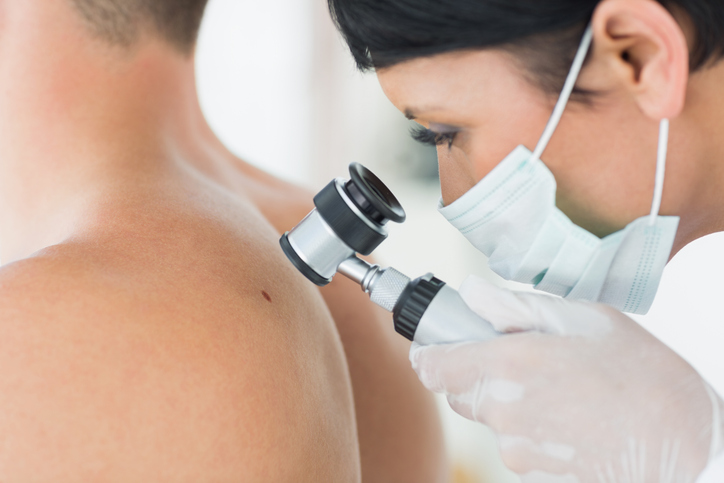
The goal of any cancer screening program is to detect disease at a stage when treatment is more effective than it would be after signs or symptoms occur, and this would subsequently lead to a decrease in mortality. A screening recommendation must also define which individuals benefit the most from these screenings.
While there are many types of skin cancer, melanoma represents the primary public health concern. It is responsible for the majority of skin cancer–related deaths, and stage at diagnosis directly correlates with mortality.1 While early detection is critical to survival, the U.S. Preventive Services Task Force (USPSTF) asserts in their 2023 recommendations that “little evidence exists regarding the benefit of skin cancer screening with melanoma mortality.”2,3
The American Academy of Dermatology and the American Cancer Society also do not provide specific guidelines for skin cancer screening, but both encourage all patients to regularly perform skin self-exams and to notify a physician of any new or changing spots.4
The American Cancer Society cites several risk factors in an attempt to assist clinicians and patients in defining populations at higher-than-average risk for skin cancer.5 While melanoma is the main target for early detection, these risk factors also apply to the most common skin cancers: basal cell and squamous cell cancer.
Patient populations
Age range for screening
The median age of diagnosis of melanoma is 65. Patients ages 35-75 with one other risk factor listed below are considered higher risk.6 These patients benefit most from conducting self-skin exams and should consider routine skin surveillance.
Risk factors
These risk factors are categorized as personal history, family history, physical features, or exposure to activities. These risk factors are all known to significantly increase the risk of skin cancer.
- Personal history: Any patient with a history of melanoma or nonmelanoma skin cancer, a known CDKN2a mutation carrier, or who is immunocompromised.
- A CDKN2a mutation is a rare genetic syndrome that increases the risk of both melanoma and pancreatic cancer.
- Immunosuppressed individuals are those who have suppressed immune systems due to a disease (e.g., AIDS) or medication (e.g., anti-rejection drugs for organ transplants or immunosuppressants for autoimmune disorders).
- Family history: Any patient with melanoma in one or more first-degree relatives (parents, siblings, children)
- Personal physical features: Patients exhibiting one or more of these physical characteristics — light skin (Fitzpatrick types I–III), blonde or red hair, more than 40 total nevi, more than two atypical nevi, or severely sun-damaged skin.
- Physical activity associated with UV overexposure: A history of multiple blistering or peeling sunburns or repeated use of indoor tanning.
In summary, currently, there is insufficient data to support the assertion that skin screening reduces melanoma mortality. All patients should be educated on how to perform skin self-exams and should notify a clinician of any concerning lesions. This summary provides a logical approach to help patients and clinicians determine who should also be considered for skin cancer screening.
LEARN MORE ABOUT SKIN CANCER SCREENING AT NORTHSIDE.
References:
- National Cancer Institute Surveillance, Epidemiology, and End Results Program. “Cancer Stat Facts.” Accessed May 4, 2022. https://seer.cancer.gov/statfacts/.
- U.S. Preventive Services Task Force. “Screening for Skin Cancer in Adults: US Preventive Services Task Force Recommendation Statement.” JAMA 329, no. 15 (April 18, 2023): 1290–95. https://doi.org/10.1001/jama.2023.4342.
- Henrikson, N., A. Ivlev, et al. “Skin Cancer Screening: Updated Evidence Report and Systematic Review for the US Preventive Services Task Force.” JAMA 329, no. 15 (April 18, 2023): 1296–1307.
- Cronin, Terrence. “AAD Statement on USPSTF Recommendation on Skin Cancer Screening.” April 18, 2023. https://www.aad.org/news/aad-statement-uspstf-cancer-screeening.
- American Cancer Society. “Risk Factors for Melanoma.” https://www.cancer.org/cancer/types/melanoma-skin-cancer/causes-risks-prevention/risk-factors.html.
- Johnson, Melissa M., Sancy A. Leachman, et al. “Skin Cancer Screening: Recommendations for Data-Driven Screening Guidelines and a Review of the US Preventive Services Task Force Controversy.” Melanoma Management 4, no. 1 (2017): 13–37. https://www.ncbi.nlm.nih.gov/pmc/articles/PMC5480135/.